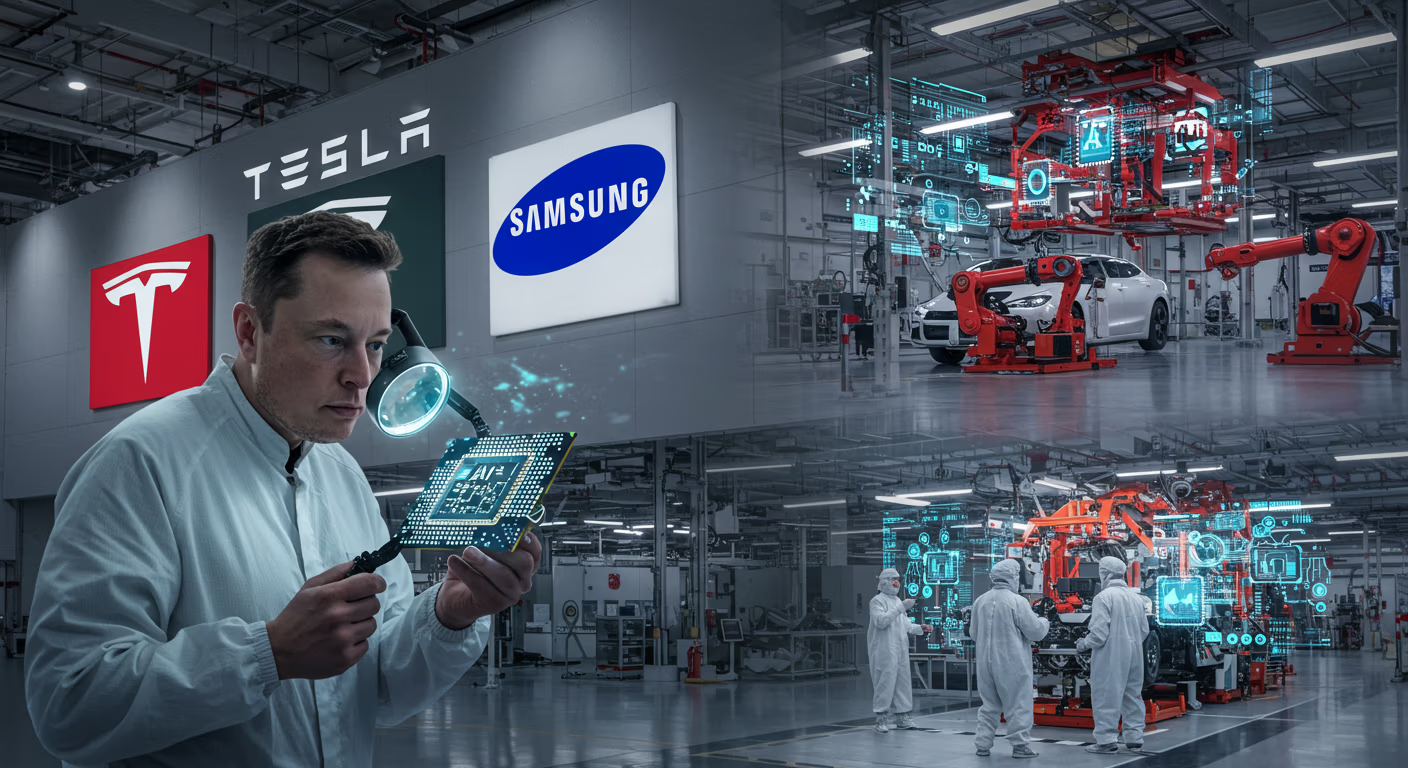
In a landmark development that reshapes the global semiconductor landscape and propels the future of autonomous vehicles, Samsung Electronics has signed a multiyear, $16.5 billion agreement with Tesla Inc. to manufacture next-generation AI chips. The chips—dubbed AI6—will power Tesla’s future fleet of self-driving vehicles, with production slated for a cutting-edge fabrication facility in Taylor, Texas, by the end of 2033.
This massive agreement is more than just a business deal—it’s a strategic alliance between two titans of technology. It reflects growing momentum in artificial intelligence (AI), semiconductor innovation, and electric vehicles (EVs). For Samsung, it represents a crucial win for its struggling foundry business. For Tesla, it marks a step closer to achieving the elusive dream of full self-driving technology.
In this comprehensive article, we’ll explore the implications of this agreement, its impact on the semiconductor and automotive sectors, and why this collaboration could be a defining moment in the race toward AI-powered transportation.
Table of Contents
- The Samsung-Tesla Chip Deal: A Game-Changer
- Inside the $16.5 Billion Agreement
- What Is the Tesla AI6 Chip?
- Why Texas? The Strategic Role of the Taylor Fab
- Samsung’s Foundry Division: From Struggles to Strength
- TSMC vs. Samsung: Battle for AI Chip Supremacy
- U.S. Chip Policy and the CHIPS Act: Catalyzing Domestic Production
- Elon Musk’s Vision: From AI4 to AI6 and Full Autonomy
- Tesla’s Self-Driving Timeline: Hype or Reality?
- The Global Race for AI Dominance
- How This Impacts Investors and Tech Markets
- Final Thoughts: The Road Ahead
1. The Samsung-Tesla Chip Deal: A Game-Changer
The multiyear contract between Samsung and Tesla has sent shockwaves through both the semiconductor and EV industries. Announced in July 2025, the deal represents a rare convergence of interests between a traditional electronics behemoth and a modern automotive innovator.
Samsung will produce custom AI chips for Tesla’s future vehicles at its upcoming fab in Texas. These chips are designed to support autonomous driving, an area where Tesla is betting its future. With the global EV market becoming increasingly competitive, having a proprietary, high-performance AI chip could give Tesla a critical edge.
2. Inside the $16.5 Billion Agreement
The deal, valued at 22.8 trillion won, will run until the end of 2033. According to Tesla CEO Elon Musk, the amount disclosed is only “the bare minimum,” and real production output could be “several times higher.”
Samsung’s fabrication facility will exclusively produce the AI6 chip, which Musk has said will power Tesla’s upcoming autonomous hardware suite. In addition to chip manufacturing, Musk is expected to personally oversee aspects of production optimization, signaling a high level of involvement and collaboration.
3. What Is the Tesla AI6 Chip?
The AI6 chip is the next-generation semiconductor built specifically for Tesla’s advanced Full Self-Driving (FSD) system. It will succeed the current AI4 chip, also manufactured by Samsung, and the upcoming AI5 chip being produced by TSMC.
While details about the architecture are scarce, the AI6 is believed to include:
- High-efficiency neural processing units (NPUs)
- Advanced machine learning acceleration
- Support for real-time sensor fusion
- Enhanced power efficiency for in-vehicle computing
With the AI6 chip, Tesla hopes to leapfrog competitors in the autonomous driving space, where real-time decision-making is paramount.
4. Why Texas? The Strategic Role of the Taylor Fab
The Taylor, Texas facility is central to Samsung’s ambitions in the U.S. semiconductor market. Backed by the U.S. CHIPS and Science Act, the plant received up to $4.75 billion in funding and tax incentives, potentially reaching $9 billion.
By manufacturing in the U.S., both Samsung and Tesla:
- Avoid tariffs on imported components
- Secure supply chains amid geopolitical tensions
- Tap into American engineering talent
- Support domestic tech industry growth
This move also aligns with U.S. policy to rebuild its semiconductor base and reduce reliance on overseas fabs like those in Taiwan and South Korea.
5. Samsung’s Foundry Division: From Struggles to Strength
Samsung has long been a dominant player in memory chips, but its foundry business has lagged behind rival TSMC (Taiwan Semiconductor Manufacturing Co.). In Q1 2025, Samsung held just 7.7% of the global foundry market, compared to TSMC’s commanding 67.6%.
The Tesla deal could signal a turnaround. It:
- Fills underutilized capacity
- Validates Samsung’s advanced manufacturing capabilities
- Builds confidence for other potential clients
This win comes after Samsung delayed the full ramp-up of its Texas fab to 2026 due to underwhelming demand—making the Tesla contract a much-needed lifeline.
6. TSMC vs. Samsung: Battle for AI Chip Supremacy
With both companies advancing toward 2-nanometer fabrication, the Tesla deal intensifies the rivalry between Samsung and TSMC. While TSMC will still supply Tesla with AI5 chips, the transition to AI6 represents a shift in strategic preference.
TSMC still leads in:
- Process maturity
- Client portfolio (Apple, AMD, NVIDIA)
- Manufacturing yield
However, Samsung is positioning itself as a viable alternative—especially for U.S.-based companies looking to diversify suppliers amid growing concerns over Taiwan’s geopolitical stability.
7. U.S. Chip Policy and the CHIPS Act: Catalyzing Domestic Production
The 2022 CHIPS and Science Act has played a pivotal role in reshaping the semiconductor ecosystem. The Act offers:
- $39 billion in grants
- Billions in tax credits
- Support for R&D and workforce training
Samsung’s investment in Texas—boosted by this legislation—aligns perfectly with Washington’s vision to restore American chip supremacy. It also sets a precedent for foreign firms to expand U.S. operations, creating jobs, infrastructure, and supply chain resilience.
8. Elon Musk’s Vision: From AI4 to AI6 and Full Autonomy
Musk has long promised a future of fully autonomous Teslas. However, despite years of development and marketing under the “Full Self-Driving” label, Tesla’s vehicles still require human supervision.
With the AI6 chip, Musk aims to:
- Enable real-time decision-making
- Reduce system latency
- Improve energy efficiency
- Support Level 4 or 5 autonomy
He has suggested that 2026 could mark the arrival of fully autonomous vehicles—though skeptics remain unconvinced.
9. Tesla’s Self-Driving Timeline: Hype or Reality?
Since 2016, Tesla has claimed that all new vehicles include the hardware needed for autonomy. Yet, many early adopters now feel misled. The shifting chip strategy—from AI4 to AI5 to AI6—adds fuel to this fire.
Some key concerns include:
- Rapid obsolescence of hardware
- Lack of retrofit options for older models
- Legal and regulatory hurdles
- Safety concerns in real-world driving
While Tesla recently launched a robotaxi pilot in Austin, the service still uses human safety drivers and has exhibited traffic law violations, as seen in user-uploaded videos.
10. The Global Race for AI Dominance
The Tesla-Samsung collaboration represents more than a business deal—it’s a chapter in the global race for AI supremacy. As countries and corporations vie for leadership in autonomous systems, high-performance AI chips are the linchpin.
Whether in:
- Smart cities
- Robotics
- Healthcare AI
- Autonomous vehicles
…the ability to design and fabricate proprietary semiconductors is becoming a national priority.
11. How This Impacts Investors and Tech Markets
The deal has already made waves on global stock markets. After the announcement:
- Samsung’s shares surged 6.8%
- Its supplier Soulbrain rose 16%
- Tesla shares climbed over 1%
This reflects growing investor confidence in:
- Samsung’s foundry revival
- Tesla’s self-driving roadmap
- The long-term synergy between EVs and semiconductors
Moreover, the partnership may signal future collaborations between legacy tech firms and next-gen AI pioneers.
12. Final Thoughts: The Road Ahead
The $16.5 billion agreement between Samsung and Tesla could define the next decade of innovation in AI and transportation. It:
- Strengthens Samsung’s position in the global chip industry
- Accelerates Tesla’s autonomous driving goals
- Leverages U.S. policy incentives to boost domestic production
However, challenges remain—from technology hurdles and customer trust to geopolitical tensions and market competition. If successful, this partnership could be remembered as the moment the AI-driven future of mobility truly began.