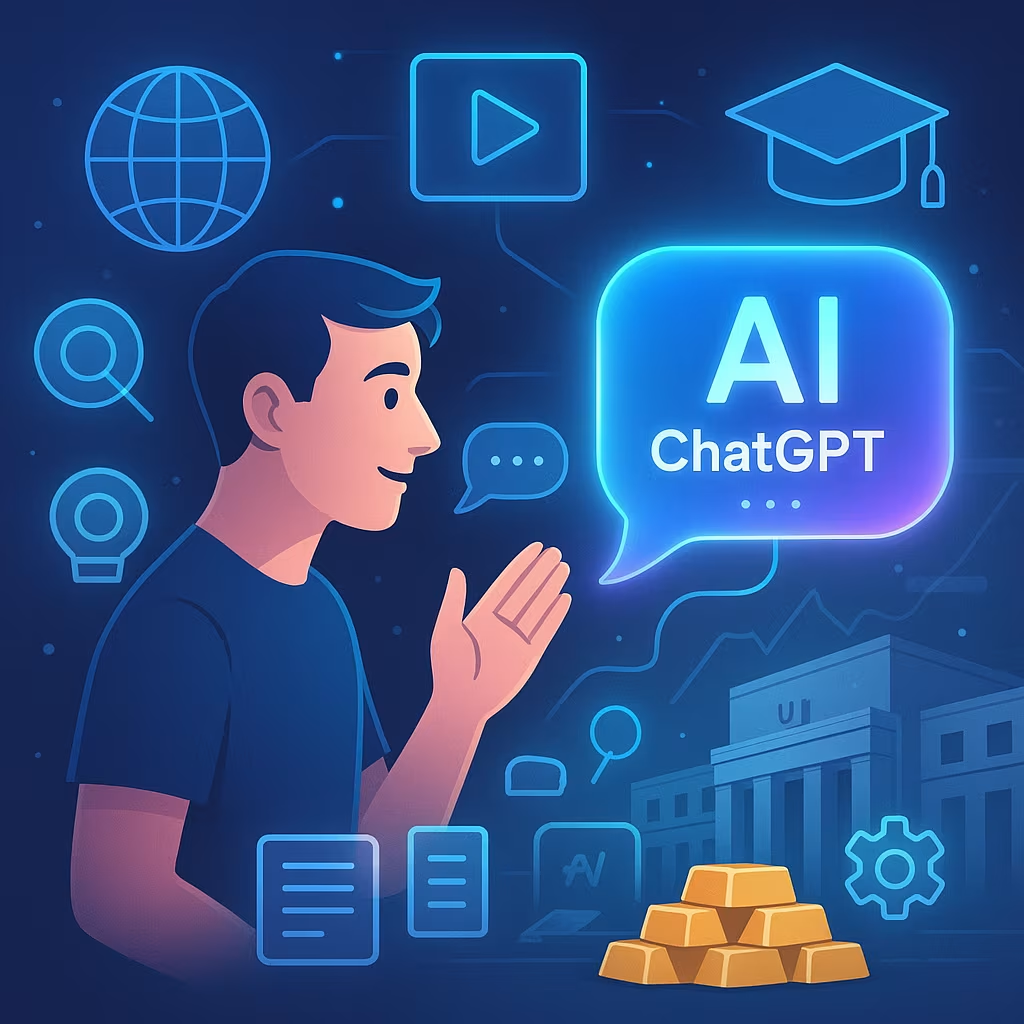
When ChatGPT launched in late 2022, it was hailed as a fascinating experiment in generative artificial intelligence. But in just a short time, it has become something far more transformative — a force reshaping the internet itself. From how we search and learn to how we write, build businesses, and even entertain ourselves, ChatGPT has rapidly become a digital utility — like Google or email — embedded in the daily experience of millions.
As ChatGPT evolves from novelty to infrastructure, it is bringing about a quiet but powerful revolution. It’s not just changing what we do online; it’s changing how the internet operates, how value is created, and how humans interact with information in real time.
This article explores how ChatGPT is redefining the web as we know it — and why we’re only at the beginning of this transformation.
From Static Web to Interactive Intelligence
Traditionally, the internet has been a place where users seek information and navigate static content — websites, articles, forums, and databases. Search engines like Google helped users find answers by crawling and ranking pages. But ChatGPT changes the paradigm. It allows users to interact directly with knowledge, not just browse it.
Instead of typing keywords into a search box and clicking through links, users now ask questions conversationally and receive synthesized, human-like responses in real time. The result? A shift from information retrieval to information dialogue.
This evolution has implications for:
- Search engines, as users skip over traditional results pages
- Content creators, whose material may be summarized, paraphrased, or bypassed
- Users, who expect faster, clearer, and more personalized answers
It’s not just a new interface — it’s a new way of thinking about digital knowledge.
AI as a New Layer of the Internet
ChatGPT and other large language models are becoming an intelligence layer that sits atop the internet. They don’t replace websites or apps — they help users extract meaning from them more efficiently.
In this sense, AI is emerging as a universal translator, personal assistant, and creative collaborator, rolled into one. Whether you’re writing an email, drafting code, summarizing a contract, or researching a topic, ChatGPT can streamline the process, reduce friction, and accelerate outcomes.
That shift is transforming the internet into an actionable space — one where users don’t just find information, but immediately use it, reshape it, and engage with it through AI-mediated workflows.
Impact on Search Engines and SEO
One of the most visible disruptions has been in the realm of search. ChatGPT’s ability to provide direct answers has led many to replace traditional search queries with AI prompts. As a result:
- Google has responded with AI Overviews and Gemini integration to stay competitive
- SEO strategies are shifting, with creators focusing more on AI visibility than just page ranking
- Affiliate and ad-driven content is under pressure, as users skip traditional blogs and comparison sites
In this new world, the value lies in training data, semantic clarity, and AI-integrated platforms. Companies are rethinking how they get discovered and how they interact with users who may never visit their websites directly.
Democratizing Access to Expertise
ChatGPT is also changing who gets to be an expert — and how fast. With access to powerful models, anyone can now:
- Draft a legal contract without a lawyer
- Write code without formal training
- Translate documents in real time
- Understand complex scientific topics in plain English
- Start a business with automated tools and advice
This democratization of knowledge has lowered the barrier to entry for entrepreneurship, education, and professional productivity. While it doesn’t replace deep expertise, it expands access to tools and ideas that were once out of reach for many.
As a result, we’re seeing an explosion of micro-creators, solo founders, and self-taught professionals, all powered by AI.
Content Creation at the Speed of Thought
One of ChatGPT’s most significant effects is on content creation. The internet was already flooded with content, but now that AI can assist — or even fully generate — articles, marketing copy, emails, scripts, and reports, the scale of content production has gone exponential.
Businesses, bloggers, marketers, and students are using ChatGPT to:
- Write faster
- Brainstorm more ideas
- Translate across languages
- Personalize communication
- Produce content in multiple formats (text, code, poetry, instructions)
The upside is that creativity is more accessible. The downside is that the internet risks becoming saturated with synthetic, low-quality, or repetitive content, forcing platforms and readers to develop better filters for originality, authority, and intent.
Real-Time Personalization and Assistance
ChatGPT is ushering in a new era of real-time, contextualized assistance. Unlike static help pages or automated FAQs, ChatGPT can understand the nuances of a user’s situation and respond accordingly.
In fields like:
- Customer service, ChatGPT is handling queries without wait times
- Education, it serves as a 24/7 tutor for students
- Healthcare, it helps patients understand symptoms or insurance plans
- Software development, it writes and debugs code collaboratively
- Finance, it explains contracts, portfolios, or taxes conversationally
This kind of adaptive AI marks a new internet where users don’t just consume content — they co-create outcomes in real time.
A New Era of Digital Companionship
Beyond productivity, ChatGPT is also influencing how people relate to technology emotionally. Many users now interact with AI for:
- Companionship
- Brainstorming
- Mental wellness support
- Creative exploration
- Daily planning or journaling
The rise of personalized AI agents — trained on individual preferences and histories — is shaping an internet that feels more like a collaborative space than a static archive. While this raises valid concerns around over-reliance and ethical boundaries, it also represents a radically more human interface with the web.
Challenges and Questions Ahead
As transformative as ChatGPT has been, it also raises serious challenges:
- Content ownership: If AI summarizes your blog post, who gets the credit?
- Bias and misinformation: ChatGPT’s outputs reflect its training data — not all of which is accurate or neutral
- Data privacy: As more queries are directed to AI systems, what happens to that user data?
- Economic displacement: What happens to jobs tied to content creation, search optimization, or customer service?
As the AI revolution unfolds in real time, regulators, technologists, and users must work together to ensure that the internet remains open, equitable, and trustworthy.
ChatGPT is more than a chatbot. It’s a foundational shift in how we interact with the internet, turning search into conversation, websites into interfaces, and users into collaborators. It’s democratizing access, accelerating creativity, and raising profound questions about the future of digital life.
As more people rely on AI to learn, create, and connect, the internet itself is evolving — not as a static library of information, but as a dynamic, AI-driven space that thinks with you.
The revolution isn’t coming. It’s happening now.